



Offshore Development Team Management: 10 Best Practices

Managing an offshore development team requires clear ownership, consistent communication, and reliable development processes. When engineers work across different locations and time zones, even small gaps in documentation or decision making can delay delivery.
The solution is not more meetings or closer supervision. It is a working structure that allows remote developers to understand priorities, make technical decisions within their responsibilities, and deliver software that meets agreed standards.
These ten best practices explain how to manage remote offshore developers effectively, from daily collaboration to code quality, security, and performance measurement.
1. Define Clear Roles and Technical Ownership
Every developer should know what they are responsible for, who approves their work, and where to raise technical questions.
Unclear ownership becomes particularly problematic when different teams contribute to the same application. A backend developer might complete an API change while a frontend developer is still waiting for confirmation about the expected response format.
To avoid these situations, define ownership at three levels:
Product ownership: Who decides what should be built and which features take priority?
Technical ownership: Who approves architecture, coding approaches, and significant changes?
Delivery ownership: Who tracks progress, resolves dependencies, and confirms that work meets acceptance criteria?
Document these responsibilities in a shared workspace. Developers should be able to find the right decision maker without searching through old conversations.

2. Choose the Right Communication Method
Effective offshore development team management depends on predictable communication, not constant availability.
The same principles apply when external engineers join an internal development organization through software staff augmentation. Developers need access to the relevant conversations, technical decisions, and project requirements to contribute effectively.
Which Communication Channel Should You Use?
For example, a critical production issue may require an immediate conversation, while a question about a future feature can usually be documented in the project management system.
This distinction reduces interruptions and gives developers more uninterrupted time to work.
3. Create a Development Workflow Everyone Understands
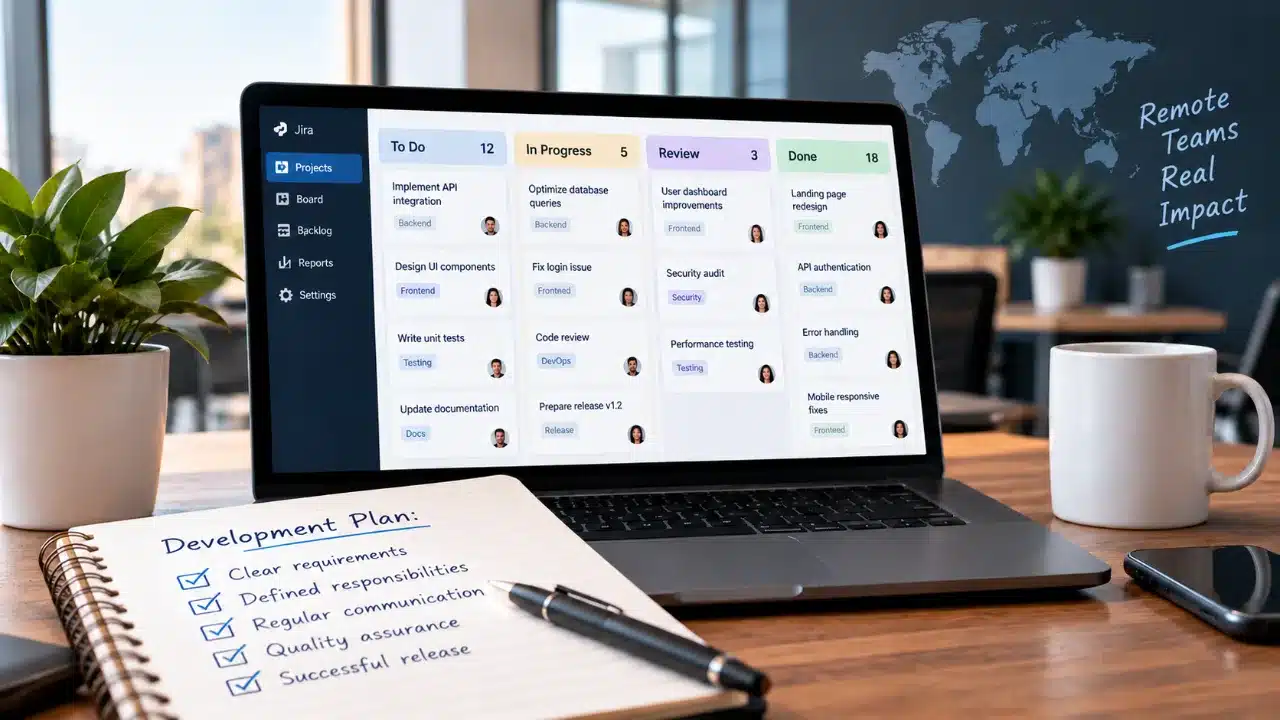
A shared workflow makes progress visible without requiring developers to report every action.
For Agile teams, this typically means maintaining a prioritized backlog, planning development work, reviewing completed changes, and collecting feedback after delivery.
Each task should describe the expected outcome, relevant dependencies, acceptance criteria, and assigned owner.
A Practical Offshore Development Workflow
Figure: Example development workflow for a distributed engineering team.
The workflow should be adapted to the project rather than followed mechanically. A small maintenance change may need fewer approvals than a major architectural update.
The important part is knowing what happens next and who is responsible at every stage.
4. Measure Delivery Quality, Not Online Activity
Monitoring working hours or online status does not reveal whether an offshore development team is delivering reliable software.
Engineering managers should evaluate outcomes using a combination of delivery, quality, and collaboration indicators.
Key Metrics for Offshore Development Teams
Metrics should be interpreted together. Faster deployment is not an improvement if production defects increase.
Rather than setting arbitrary targets, establish a baseline and investigate meaningful changes over time.
5. Manage Time Zone Differences Without Extending Working Days
Distributed teams do not need identical working hours to collaborate successfully.
Identify a reasonable overlap period for activities requiring live interaction, such as planning, technical discussions, and urgent decisions.
Outside those hours, use asynchronous communication.
A useful daily update answers three questions: What was completed? What comes next? Is anything blocking progress?
For example, a developer finishing work in one time zone can document an unresolved API dependency before logging off. The product manager can respond during their own working day, allowing the developer to resume with clear instructions.
This approach supports continuity without requiring everyone to remain available outside normal working hours.
6. Invest in Documentation and Developer Onboarding
An offshore development team should not depend on individual employees to explain how the system works.
Maintain accessible documentation covering architecture, development environments, coding conventions, API specifications, deployment procedures, and important technical decisions.
Documentation becomes especially valuable when businesses need to hire offshore developers to expand an existing engineering team.
New team members should be able to understand the application’s structure, access the appropriate development tools, and complete an initial task without relying on repeated verbal explanations.
Example: A Practical Onboarding Sequence
First stage: Provide approved access to repositories, development environments, relevant documentation, and communication channels.
Second stage: Introduce the product architecture, development workflow, coding standards, and technical stakeholders.
Third stage: Assign a manageable initial task with clear acceptance criteria and an available reviewer.
Fourth stage: Review the developer’s experience, resolve documentation gaps, and progressively increase task complexity.
The goal is not to rush onboarding. It is to establish the conditions for independent, reliable contributions.
7. Apply Consistent Code Quality Standards
Internal and offshore developers should follow the same engineering standards.
This includes consistent coding conventions, pull request reviews, automated testing, and release procedures.
A practical quality control process should verify that:
- Code follows the project’s agreed conventions.
- Changes are reviewed by an appropriate team member.
- Automated tests pass before integration.
- Significant changes are documented.
- Deployment and rollback procedures are understood.
For example, an offshore developer modifying authentication logic should not bypass existing security tests or approval processes simply because the work is being completed remotely.
Code quality is a shared engineering responsibility, not a separate requirement for external developers.
8. Protect Source Code, Credentials, and Business Data
Offshore development often requires access to valuable intellectual property, internal systems, and sensitive information.
Access should be granted according to responsibilities rather than providing every developer with the same permissions.
Use appropriate authentication controls, secure credential management, and documented access review procedures.
When someone changes roles or leaves the project, permissions should be updated promptly.
Confidentiality, intellectual property ownership, and applicable data protection obligations should also be addressed in the working agreement.
These practices help maintain security without making everyday development unnecessarily complicated.
9. Build Trust and Connect Developers to Product Goals
Remote engineers produce better technical decisions when they understand the product they are building.
Instead of assigning tasks without context, explain the problem, the intended user experience, and relevant business constraints.
For example, a request to optimize a checkout process becomes more useful when developers understand where customers encounter difficulties.
Include offshore engineers in relevant planning discussions, invite technical feedback, and communicate changes in product priorities.
At Emyoli Technologies, software development and team augmentation are centered on helping businesses strengthen their technical capabilities. Effective collaboration requires aligning development work with the product’s actual objectives.
10. Review Your Management Process Regularly
Even well organized teams encounter bottlenecks.
Regular retrospectives provide an opportunity to identify recurring problems and make targeted improvements.
Look for patterns such as delayed code reviews, unclear requirements, repeated defects, or tasks waiting too long for approval.
If developers consistently wait for the same technical decision maker, the solution may be to delegate certain decisions or improve documentation rather than schedule additional meetings.
A useful retrospective should produce specific improvements, assign responsibility, and evaluate whether those changes actually helped.
Offshore Development Team Management Checklist
Use this checklist to review whether your offshore development team has the foundations for effective collaboration.
A checklist is a starting point, not a substitute for evaluating real project results. Review it periodically as the team, product, and technical requirements evolve.
Conclusion
Successful offshore development team management is built on clear responsibilities, reliable communication, consistent engineering standards, and visibility into delivery outcomes.
The most effective teams are not necessarily those with the most meetings or the largest number of developers. They are the ones that can make decisions, resolve blockers, and deliver quality software without unnecessary friction.
At Emyoli Technologies, we help businesses strengthen their software development capabilities through technical expertise and staff augmentation. If you are looking to improve collaboration with remote engineers or expand your development capacity, we can help you explore an approach that fits your project.
Frequently Asked Questions
1. How many developers should an offshore development team have?
There is no universal team size. The right structure depends on project complexity, technical requirements, existing engineering capacity, and delivery responsibilities. Clearly defined roles matter more than adding developers without a coordinated workflow.
2. Can offshore developers work effectively with an internal engineering team?
Yes. Effective integration requires shared project tools, common coding standards, access to relevant documentation, and clear decision making responsibilities. Offshore engineers should participate in the same development processes as internal team members.
3. How often should offshore development teams hold meetings?
Meeting frequency depends on the project and team structure. Short coordination meetings may be useful during active development, while planning and technical reviews can be scheduled according to actual needs. Written updates can replace many routine meetings.
4. What should a company prepare before onboarding offshore developers?
Prepare technical documentation, repository access, development environment instructions, assigned responsibilities, and an initial set of clearly defined tasks. Identify who will provide technical guidance and review the developer’s first contributions.